Net operating income (NOI) is the single number that determines your property's value in a cap-rate-driven market. Increasing NOI by $20,000 a year at a 7% cap rate adds nearly $285,000 to your property's appraised value. The math is unforgiving — but it also rewards operators who pay attention to the right details.
A lot of NOI advice is written for apartment owners or gross-lease office buildings. For commercial strip centers and NNN retail, the levers look different. Most of your day-to-day operating costs — landscaping, janitorial, pest control, parking lot maintenance — are common area maintenance (CAM) expenses billed back to your tenants. You're not absorbing those costs, they are. What you're managing is the accuracy of that passthrough, the exposure during vacancy, and the capital items that genuinely do fall on you.
For a deeper primer on how NOI drives commercial property valuation, CCIM Institute and NAIOP are both strong resources for owners and investors looking to sharpen their underwriting fundamentals.
Here are five places where Houston commercial owners routinely leave money on the table.
1. CAM Reconciliation Leakage
In a NNN or modified gross lease, your operating expenses flow through to tenants as CAM. The vendor bills land on your desk, you pay them, and at year-end you reconcile and collect. That's the structure — but it only works if your property manager is running clean books and actually capturing everything.
Unbilled expenses, missed reconciliations, utilities charged to the wrong account, admin fees left uncollected — all of it shows up as a direct NOI reduction. You paid the expense, you just didn't collect it back. In a well-run portfolio, CAM reconciliation is tight, documented, and completed on schedule. If your manager can't show you a clean year-end reconciliation package with every expense tied to a line item, that's where the leakage starts.
2. Vacancy Carrying Costs
This is where CAM expenses actually become the owner's problem. When a suite is vacant, there's no tenant to absorb that unit's pro-rata share of common area costs. You're paying landscaping, janitorial, pest control, and parking lot maintenance on space that's generating zero revenue — and you're doing it on top of lost base rent and ongoing debt service.
Here's what a vacant 1,200 SF suite typically costs a strip center owner each month:
| Cost Item | Monthly | 3 Months Vacant | 6 Months Vacant |
|---|---|---|---|
| Lost base rent ($18/SF/yr) | $1,800 | $5,400 | $10,800 |
| CAM absorbed by owner | $320 | $960 | $1,920 |
| Common area utilities | $180 | $540 | $1,080 |
| Insurance allocation | $95 | $285 | $570 |
| Total Cost of Vacancy | $2,395 | $7,185 | $14,370 |
At a 7% cap rate, six months of vacancy on a single suite represents a $205,000 drag on your appraised value. That's why days-on-market is one of the most important metrics you can hold your property manager accountable to.
3. Capital Expenditures You Actually Own
Under a NNN lease, tenants handle their own HVAC. What stays with the owner is everything structural and exterior — the roof, the parking lot, the building shell, and the common area systems. These items don't show up in your monthly operating expenses, but deferred maintenance on them destroys asset value faster than almost anything else.
A $250 roof inspection prevents a $20,000 water intrusion claim. A $4,000 parking lot seal coat extends pavement life by years and defers a $60,000 resurfacing project. Proactive capital planning on the systems you own keeps your asset in condition to command market rents and attract quality tenants — tenants who will renew.
4. Lease Administration
Your leases determine what you collect, when you collect it, and what happens when terms change. A surprising number of owners don't know exactly what their leases say about CAM caps, exclusions, escalation clauses, or renewal options — and that ambiguity almost always resolves in the tenant's favor.
A missed rent escalation is a permanent NOI loss. An uncollected CAM admin fee (typically 10–15% of CAM, which belongs to the owner) goes unnoticed for years. A renewal option that passes unaddressed turns into a below-market lease extension. The value of tight lease administration isn't visible when it's working — you only feel it when it's not.
5. Common Area Energy
Parking lot lighting, exterior fixtures, and common area electrical are among the few direct operating costs that sit entirely with the owner and don't pass through to tenants. LED retrofits for parking lot and common area lighting typically pay back in 18–24 months through reduced utility costs, with a useful life of 10–15 years after payback.
If your property is still running metal halide or older fluorescent fixtures, this is one of the cleanest capital projects available — low complexity, strong return, and a tangible improvement to the property that tenants notice.
NOI optimization for a NNN retail owner isn't about cutting CAM costs your tenants are already paying. It's about making sure you're collecting everything you're owed, minimizing vacancy, protecting the capital assets that are genuinely yours to maintain, and running lease administration that doesn't leave money sitting on the table.
Ready to talk about your property?
Schedule a consultation with the Olivewood team — we'll come prepared.
Schedule a ConsultationRelated Reading
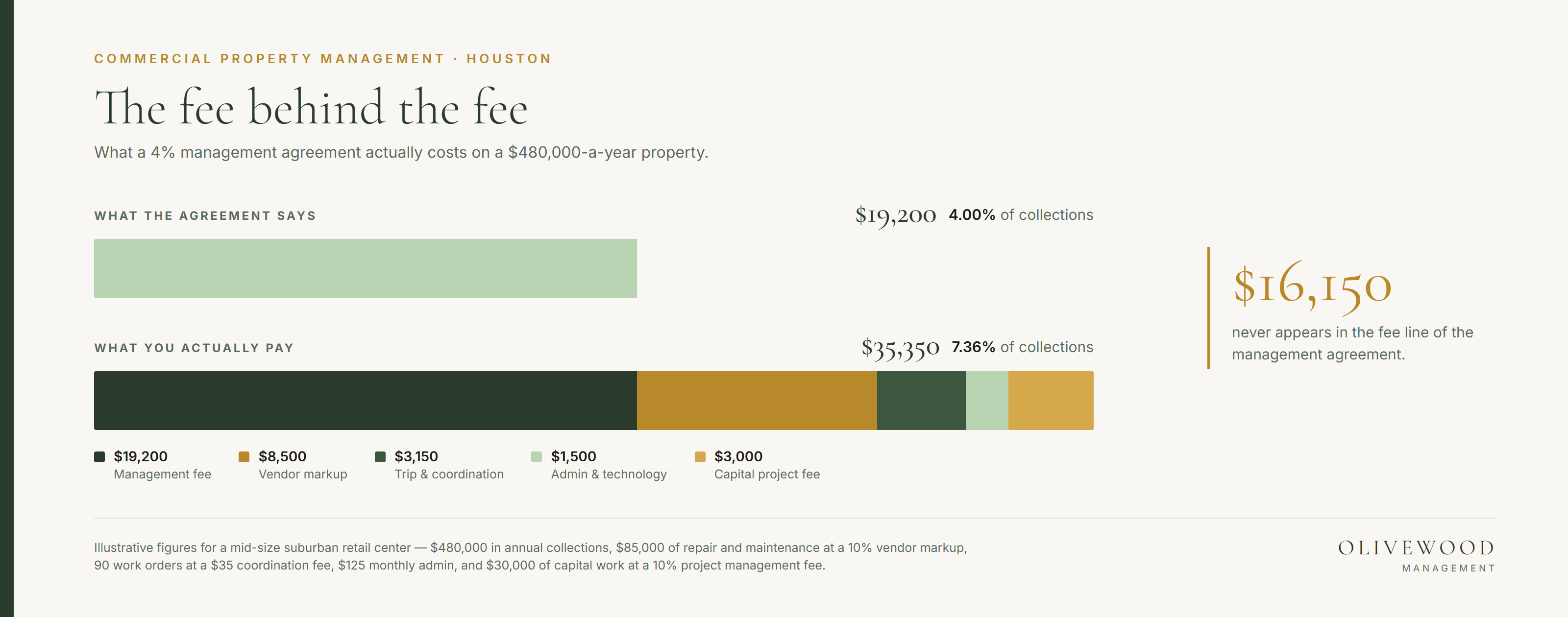
The Fee Behind the Fee: What Commercial Property Management Actually Costs Houston Owners
The Mid-Year CAM Reconciliation Checkpoint: What Houston Commercial Owners Should Be Doing Right Now