If you own a retail strip center in the Houston suburbs — Katy, Cypress, Fulshear, Sugar Land, Pearland, The Woodlands, or any of the fast-growing corridors around the metro — you already know that property taxes are one of the largest line items on your operating statement. Harris County and the surrounding appraisal districts are aggressive, and assessed values in high-growth submarkets have been climbing faster than many owners can keep up with.
Most owners file protests. Some hire tax consultants. But relatively few take advantage of one of the most effective tools available for reducing the federal tax burden on a commercial asset: a cost segregation study.
What Is a Cost Segregation Study?
A cost segregation study is an engineering-based analysis that reclassifies components of your building into shorter depreciation categories. Under standard tax treatment, a commercial building is depreciated over 39 years on a straight-line basis. But not every component of your building has a 39-year useful life — and the IRS doesn't require you to treat them as if they do.
A cost segregation study identifies building components that qualify for accelerated depreciation — typically over 5, 7, or 15 years instead of 39. These include items like:
- 5-year property: Carpet, decorative lighting, certain electrical outlets, specialized plumbing, signage, security systems
- 7-year property: Certain cabinetry, appliances, movable partitions
- 15-year property: Parking lots, sidewalks, landscaping, site drainage, fencing, exterior signage structures
For a retail strip center, the 15-year land improvement category is particularly significant. Your parking lot, curbing, striping, site lighting, retention ponds, and landscaping all qualify — and those are substantial cost components for suburban retail.
When Does the Math Make Sense?
A quality cost segregation study performed by an experienced engineering firm typically costs between $3,000 and $15,000, depending on the size and complexity of the property. That's a real cost, and it needs to produce a return that justifies the investment.
The general rule: if your property's depreciable basis is $750,000 or more, a cost segregation study is almost certainly worth it. For most Houston suburban retail centers, the reclassified components typically represent 20–40% of the total building cost — which means you're pulling forward significant depreciation into the early years of ownership.
Here's what the numbers look like on a typical suburban strip center:
| Property Value (Depreciable Basis) | Estimated Reclassified Amount (30%) | Approximate First-Year Tax Benefit | Study Cost | Net Benefit |
|---|---|---|---|---|
| $750,000 | $225,000 | $30,000–$50,000 | $3,000–$5,000 | $25,000–$47,000 |
| $1,500,000 | $450,000 | $60,000–$100,000 | $5,000–$8,000 | $52,000–$95,000 |
| $3,000,000 | $900,000 | $120,000–$200,000 | $8,000–$15,000 | $105,000–$192,000 |
Tax benefit estimates assume a combined federal and state marginal tax rate of 30–37%. Actual results depend on your tax situation, entity structure, and the specific components identified in the study.
At a $750,000 basis, you're typically looking at a 10:1 return or better on the cost of the study. Below that threshold, the economics start to thin out — the study cost stays relatively fixed while the reclassifiable amount shrinks.
What Kind of Savings Are We Talking About?
For Houston suburban retail properties, owners who complete a cost segregation study typically see a 15–30% reduction in their effective property-related tax burden in the early years of ownership. The savings come from accelerated depreciation deductions that reduce taxable income — not from lower property tax assessments directly, but from the federal tax side of the equation.
The effect is most pronounced in the first 5 years of ownership, which is why cost segregation studies are especially valuable for:
- Recent acquisitions — properties purchased in the last 1–3 years, where you haven't yet captured the accelerated depreciation you're entitled to
- New construction or significant renovations — where a large portion of costs are in short-life components
- Properties with substantial site improvements — large parking lots, extensive landscaping, site lighting — common in suburban retail
If you purchased a property years ago and never did a cost segregation study, it's not too late. A "look-back" study can capture missed depreciation from prior years and apply it in a single tax year — no need to amend prior returns.
What Greater Houston Owners Should Know About the Process
A proper cost segregation study isn't a spreadsheet exercise — it's an engineering analysis. The IRS expects these studies to be performed by qualified professionals with engineering and tax expertise. A quality study includes:
- A physical site inspection of the property
- Detailed cost identification — breaking down construction costs by component, system, and asset class
- Engineering documentation that supports each reclassification
- A final report suitable for audit defense if the IRS reviews your return
The entire process typically takes 4–8 weeks from engagement to final report, depending on property complexity and the availability of construction documentation.
How Olivewood Management Supports the Process
We work with property owners who are evaluating or executing cost segregation studies on their retail assets. While we don't perform the studies ourselves — that requires specialized engineering and tax expertise — we play a direct role in making the process efficient and accurate.
Here's what we provide:
- Construction documentation and records — original build specifications, renovation records, and capital improvement logs
- Material costs, quantities, and labor estimates — the granular data that engineering firms need to properly classify building components
- Vendor records and invoice history — supporting documentation for capital expenditures and improvements made during our management
- Coordination with the study firm — facilitating site access, answering operational questions, and ensuring the engineering team has what they need to complete the analysis efficiently
- Connections to qualified professionals — we work with experienced cost segregation firms and CPAs who specialize in commercial retail properties in the Houston market
The better the documentation going into the study, the more accurate the reclassification — and the stronger the report holds up under review. That's where having a property manager with organized records and detailed capital tracking makes a measurable difference.
Property taxes and federal tax strategy are two different levers, but they work toward the same goal: protecting your net return on a commercial asset. If you own a retail center in the Houston suburbs with a depreciable basis above $750,000 and you haven't explored cost segregation, the math is worth running.
If you'd like to talk through whether a study makes sense for your property, or if you need help pulling together the documentation to get started, reach out to our team. We'll connect you with the right professionals and make sure the process runs smoothly from start to finish.
Ready to talk about your property?
Schedule a consultation with the Olivewood team — we'll come prepared.
Schedule a ConsultationRelated Reading
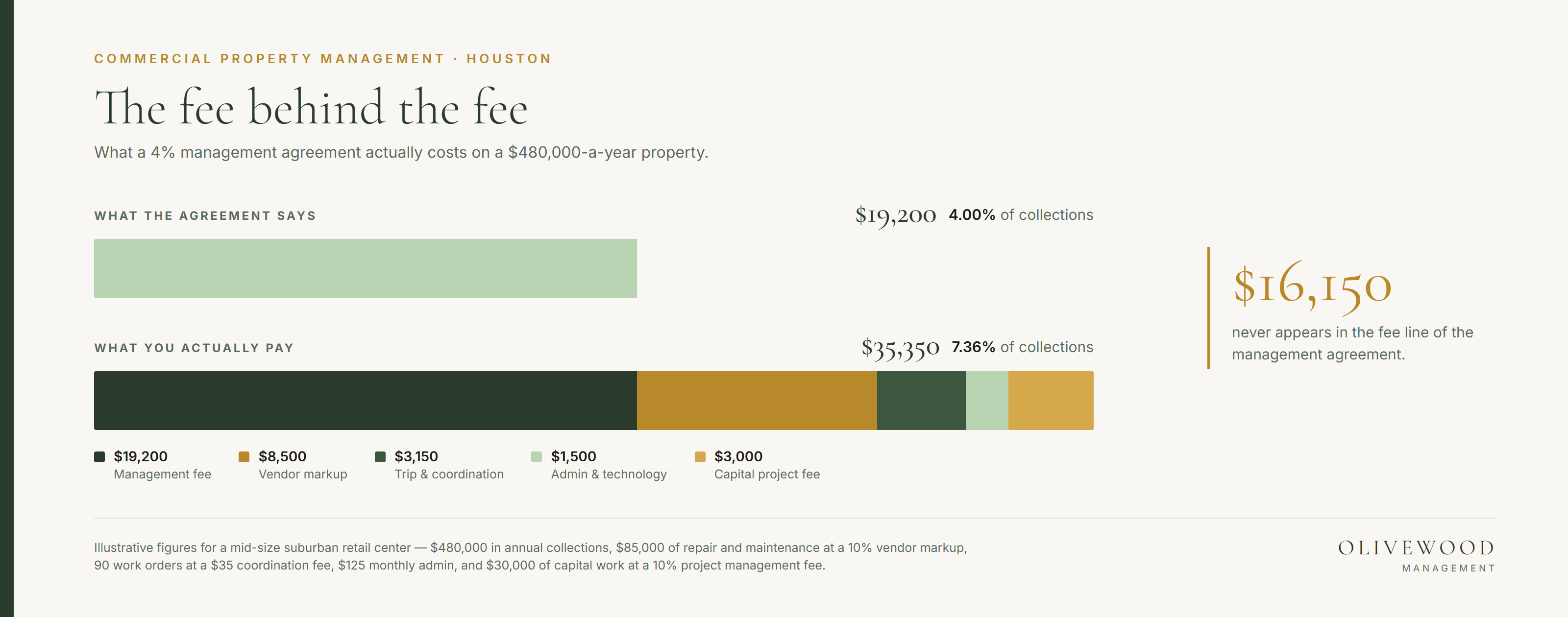
The Fee Behind the Fee: What Commercial Property Management Actually Costs Houston Owners
The Mid-Year CAM Reconciliation Checkpoint: What Houston Commercial Owners Should Be Doing Right Now