When a commercial property changes hands, most buyers focus on the big-ticket items: financing, title, lease assignments, and physical due diligence. Vendor service contracts often fall to the bottom of the list — or get overlooked entirely. That's a mistake that can cost you months of unnecessary payments.
What Happened to Us
We recently took over management of a retail center that had just been purchased. Per the closing documents, the previous management company was responsible for canceling all existing service agreements prior to the transfer of ownership.
They didn't do it.
No one contacted the landscaping company, the janitorial vendor, or the pest control service. The vendors had no idea the property had changed hands — so they kept showing up, kept invoicing, and the new owner kept receiving bills from companies they'd never hired. By the time it was sorted out, the owner had paid three months of invoices to vendors they had no contract with and no obligation to.
It shouldn't have happened. And now we make sure it doesn't.
Why Existing Contracts Don't Automatically Transfer
This is the part many buyers don't fully understand: when a property is sold, the service agreements in place are contracts between the vendor and the previous owner or management company — not the property itself. The new owner is not automatically a party to those agreements.
That means:
- You don't inherit the obligation — but you also don't inherit the coverage
- Vendors have no legal notice of the sale unless someone tells them
- Without formal cancellation, vendors continue performing services and invoicing — and recovering those payments can be difficult once they're paid
At closing, one of two things should happen: the previous owner or manager formally cancels all service agreements, or the new owner affirmatively chooses to re-execute agreements with vendors they want to keep. Either way, it needs to be in writing and it needs to happen at or before closing.
What to Request from the Previous Owner or Manager
Before you can manage a property effectively — or even know what you're walking into — you need documentation. Here's the minimum of what should be handed over at any ownership or management transition:
- All service contracts
- Last three months of invoices
- Last year's inspection reports
- Rent rolls
- Site plan
- Previous year's budget
- Updated tenant contact information
If any of these are missing, incomplete, or not provided, that's a signal to push harder before the transition is finalized. Managing a property blind to its financial history, physical condition, or tenant relationships is a recipe for expensive surprises.
What We Do Now on Every Transition
Whenever we take over a property — whether through a sale or a management company change — we follow a structured vendor transition process:
1. Request a full vendor list and all current service agreements from the previous owner or manager. This should include every active contract: HVAC, landscaping, janitorial, pest control, security, elevator, parking lot maintenance, and any specialty services. If invoices exist that don't have a corresponding written contract, those matter too.
2. Verify cancellation in writing. If the previous owner or manager is responsible for canceling agreements per the purchase contract, we confirm that cancellation letters have been sent and we request copies. We do not assume it happened.
3. Contact vendors directly based on the invoice record. Even if we have cancellation documentation, we reach out to every vendor independently — introducing ourselves as the new management, confirming the transition date, and clarifying whether we'll be continuing service or not. Vendors hear it from us directly, not through a chain of assumptions.
4. Issue new agreements for services we're continuing. If we want to keep a vendor, we re-execute a new agreement under the new ownership structure. We don't rely on assignments or verbal continuations.
5. Document everything. Every cancellation, every new agreement, every vendor communication is logged and filed. If a dispute arises six months later, we have the paper trail.
If You're the Buyer: What to Include in Your Purchase Agreement
The cleanest way to protect yourself is to address vendor contract termination explicitly in the purchase and sale agreement. The contract should specify:
- Which party is responsible for canceling existing service agreements
- The deadline for doing so (at or before closing is standard)
- What documentation is required as proof of cancellation
- What happens if a vendor invoice arrives post-closing for services performed under the old contract
If your purchase agreement is silent on this, raise it with your attorney before closing. It's a simple clause to add and a significant headache to resolve after the fact.
If You're Switching Management Companies
The same logic applies when you're not selling — just changing managers. The outgoing company likely has vendor relationships in place, and their contracts may be in their name rather than yours. Get a full accounting of every active vendor agreement before the transition date, confirm cancellations or assignments in writing, and make sure your incoming manager has every invoice and contact needed to pick up seamlessly.
Don't assume the handoff happened cleanly. Verify it.
For more on commercial real estate due diligence best practices, the CCIM Institute and IREM (Institute of Real Estate Management) are both strong resources with published guidance for buyers and property managers navigating ownership transitions.
At Olivewood Management, we handle vendor transitions as a formal part of every property onboarding — so new owners aren't left holding invoices from vendors who didn't know the property changed hands.
Ready to talk about your property?
Schedule a consultation with the Olivewood team — we'll come prepared.
Schedule a ConsultationRelated Reading

Property Management vs. Facilities Maintenance: Which One Your Retail Center or Office Building Actually Needs
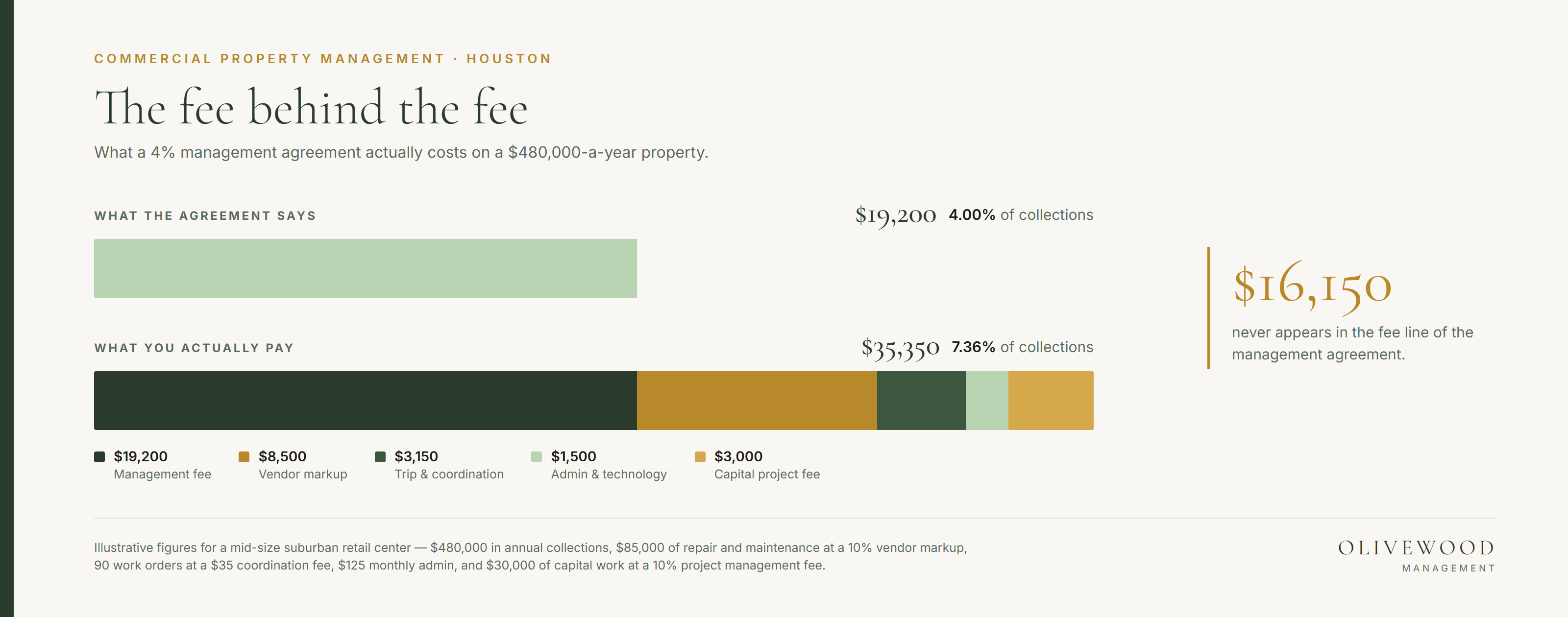
The Fee Behind the Fee: What Commercial Property Management Actually Costs Houston Owners