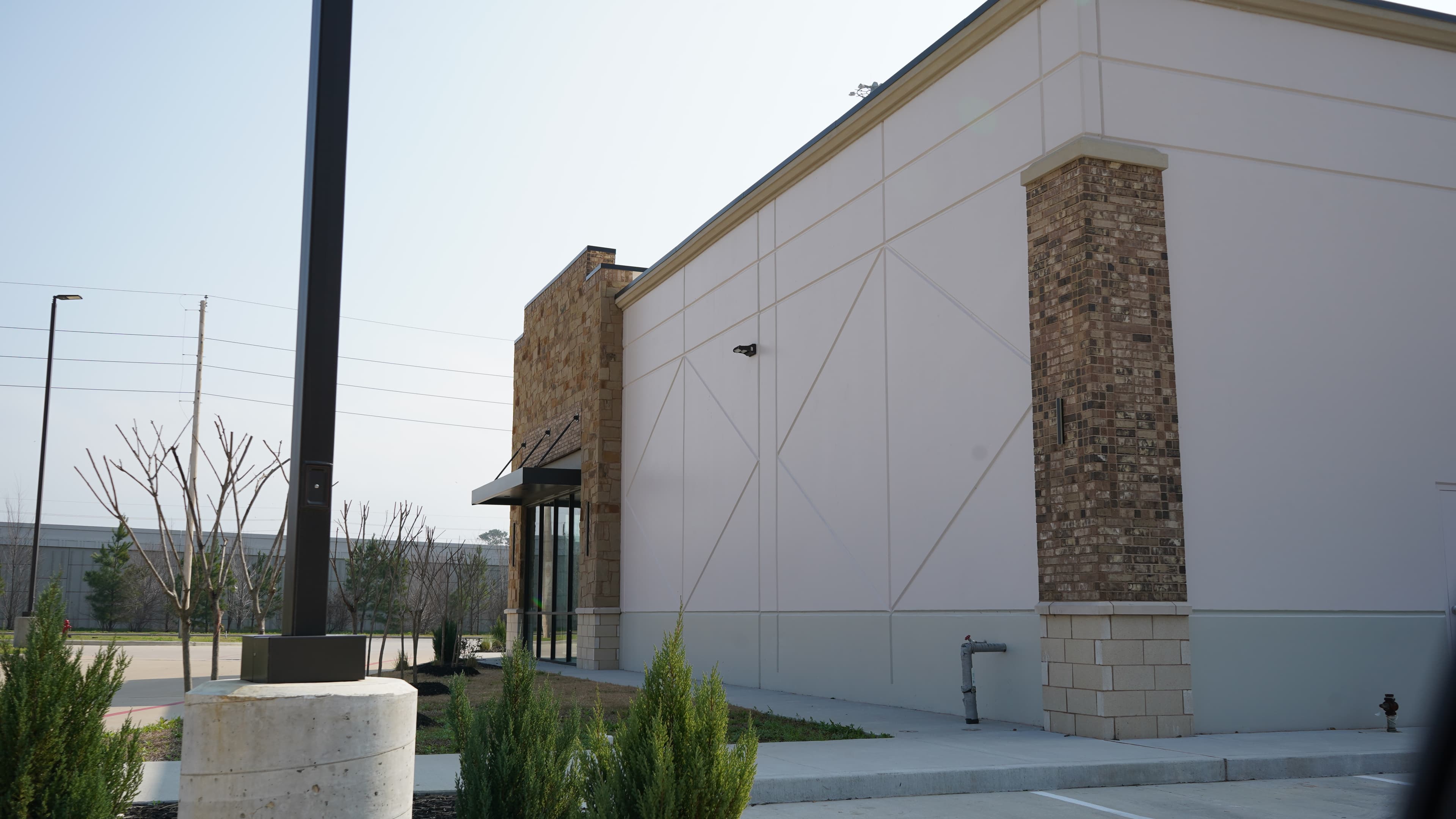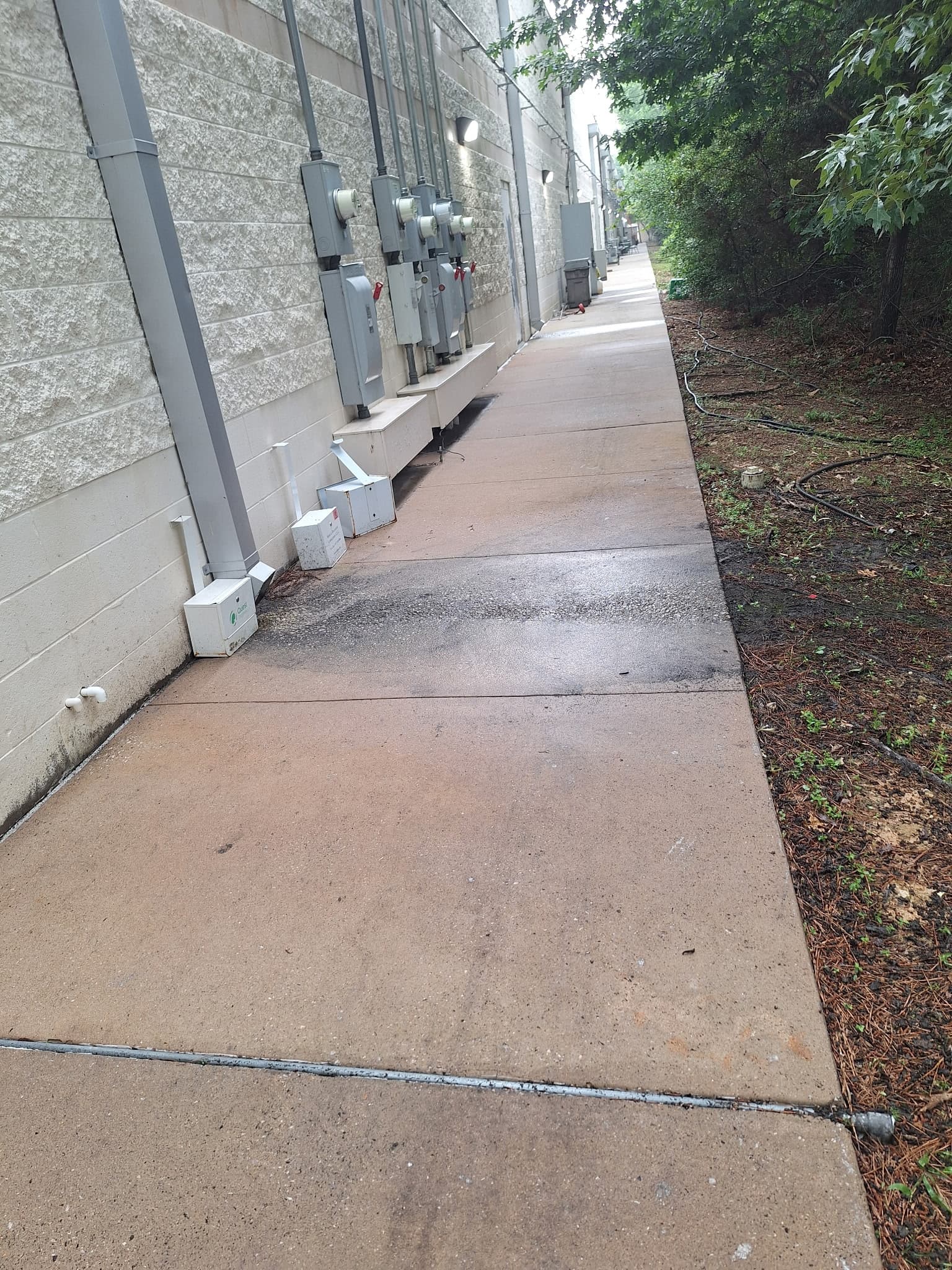
Every commercial property in Greater Houston has a back side that nobody walks. The service corridor behind the building, where the electrical meters and the grease trap and the dumpster enclosure live. Tenants do not see it. Prospects do not see it. In most of the portfolios we take over, nobody has looked at it in years.
That is exactly where the most expensive problem on the property is developing.
Go look at yours after a rain. If the downspouts and the AC condensate lines are discharging onto bare soil three feet from the building, and there is a damp stripe or a soft muddy trench that never fully dries, you are not looking at a housekeeping issue. You are looking at two capital problems compounding at the same time: a slab being pulled apart by uneven soil moisture, and a site being quietly eroded out from under its own concrete.
The correction is not exotic. Pipe the downspouts and condensate lines underground and tie them into the storm drain, the detention pond, or an engineered outfall. Budget $7,000 to $15,000 on a typical commercial building. Defer it long enough and the fix stops being a drainage job and becomes a civil engineering project with a six-figure number attached.
Why Owners Miscategorize This
Site drainage gets filed under janitorial. It belongs in the capital plan, next to the roof.
The reason it gets missed is structural: this defect never generates a tenant complaint. Nobody calls the office about a puddle behind the dumpster enclosure. Your maintenance log will show zero tickets on it for a decade. Then one day the storefront glass cracks, or the walkway drops four inches, and the number on the estimate has three more digits than it needed to have.
Every other major system on your property announces itself. The roof leaks into a suite. The HVAC dies in July and the phone rings. Drainage is the only one that fails in total silence, which is precisely why it needs to be inspected on a schedule rather than waited on.
The Physics: Two Failures, Same Cause
Houston sits on expansive clay. Clay swells when it absorbs water and shrinks when it dries. That cycle is unavoidable, and by itself it is survivable. It becomes destructive when it happens unevenly.
A slab sitting on uniformly moist soil is stable. A slab with one edge parked in permanently saturated ground while the rest of the building bakes out every August is a slab being pulled in two directions at once. Concentrated discharge from an unpiped downspout is exactly how you manufacture that condition.
The scale is worth internalizing. Houston's normal annual rainfall runs just under 50 inches. A 20,000 square foot roof sheds roughly 620,000 gallons of water a year, and every one of those gallons leaves through a downspout. If those downspouts terminate on dirt, the entire annual load is being injected into the clay at a handful of points against your foundation.
Then the second failure stacks on top. Concentrated water does not soak in politely — it scours. It carries the fines out from under sidewalks, aprons, and slab edges and leaves voids behind. It cuts channels across the back of the property. By the time a walkway visibly cracks or drops, the soil that was supporting it left the site years earlier.
The AC units never stop
Rain is seasonal. Condensate is not.
From May through October, every rooftop unit on the building is condensing water out of Houston humidity and dripping it somewhere, continuously. On a center with a dozen RTUs, that is a steady trickle onto the same patch of soil for six straight months. It is why the ground back there never dries out, and why the puddle is still there in a week with no rain in the forecast.
It is also a compliance exposure. Mechanical code requires condensate to reach an approved place of disposal and prohibits discharge that creates a nuisance. A standing puddle across a walkway your tenants' employees use every day is a slip hazard, a mosquito source, and a mold source — and every one of those lands on the owner, not the tenant, when someone gets hurt.
What We Found in The Woodlands
Last year we looked at a commercial property in The Woodlands where the complaint was almost too mundane to log: the back of the building was always wet. Downspouts and condensate lines discharging to grade in a service corridor, a permanent damp stripe, soft ground along the walkway. Nothing dramatic. Nothing a tenant had ever raised.
When the trench was opened, the ground under the edge of the walkway was gone. Undercut, a void wide enough to put an arm into. From the top, that concrete looked perfectly sound. It was sitting on air. Years of roof water had carried the soil out from underneath it and deposited it somewhere down the slope.
The correction was straightforward once the diagnosis was right: every downspout and condensate line collected into PVC boots, the walkway saw-cut, solid-wall pipe run underground with fall the entire way, and the discharge daylighted into the ravine at the back of the property — which is where that water was always supposed to go. The corridor is dry now. The next time it rains hard, the tenants will not notice anything at all. That is the entire objective.
The counter-example is the one that should worry owners. On another property, the joint between the walkway and the building had opened up so far that maintenance had been packing it with sealant year after year, chasing the gap as it widened. Nobody asked why the gap kept coming back. The answer was that the soil under the walkway was leaving the property. Eventually the whole walkway failed and had to be demolished and re-poured.
If your maintenance team is re-caulking the same joint every year, that is not a caulking problem. That is a water problem, and it is telling you the ground is moving.
Running the Math the Way an Owner Should
Here is the comparison that should drive the decision.
| Line item | Cost |
|---|---|
| Underground tie-in — downspouts and condensate piped to an engineered outfall | $7,000 – $15,000 |
| Slab stabilization on a moved foundation (piers, interior demo, restoration) | Six figures |
| Erosion remediation (retaining and erosion-control walls, regrading, armored channels) | Six figures |
| Detention or retention build-out plus civil engineering, survey, and permitting | Six figures |
| Rent abatement and tenant disruption during any of the above | Additional |
| Deferred-maintenance discount at sale or refinance | Additional |
| Payback if the tie-in prevents even one of these | Immediate |
Two things about that table are worth sitting with.
First, the bottom half is not an either/or. On a property that has been discharging onto raw dirt for fifteen years, the foundation movement and the site erosion are usually the same invoice, because the same water caused both.
Second, foundation and civil work do not just cost money — they cost tenancy. Piering a multi-tenant retail center means demolition inside occupied suites, weeks of noise and dust, and tenants who suddenly want to reopen their lease. We ran the full numbers on what a single turnover costs in our tenant turnover post; a foundation project can trigger several at once, and it lands them all in the same quarter.
There is also the piece nobody thinks about until they are under contract. A buyer's inspector will find the undermined slab edges and the standing water behind the building, and it will come back as a price reduction. Drainage neglect gets capitalized into your exit. That is the same quiet leakage we cover in NOI optimization: small operational failures that surface as large valuation hits.
What a Correct Scope Looks Like
Any competent contractor should be able to walk you through this. If they cannot, that is your answer.
- Locate the outfall. Storm drain inlet, detention pond, reservoir, or engineered ravine on the site. Confirm the tie-in point and its elevation before anything else happens.
- Establish fall. Underground drainage runs on gravity and nothing else. Grades get shot so the line runs downhill the entire way. A flat line holds water, silts up, and fails inside a year.
- Collect every source. Each downspout drops into a PVC boot at grade. Condensate lines tie into the same system rather than dribbling onto the ground.
- Trench and pipe. Solid-wall PVC, not corrugated flex, which crushes and traps sediment. Saw-cut and re-pour any walkway the line crosses.
- Backfill, compact, restore. Compacted backfill, clean concrete patches, and finish grade pulled away from the building so surface water leaves as well.
The acceptance test is simple enough for any owner to run personally: two hours after a storm, the corridor behind the building should be dry.
Why Olivewood Is the Right Partner for This
Drainage is the clearest example of what we mean when we say most property management is reactive. It is the highest-consequence defect on a commercial asset and the one least likely to ever ring the phone.
- It gets assessed at onboarding, not during an emergency. Every downspout and condensate discharge point is documented and photographed as part of our facilities maintenance intake, before it becomes a foundation conversation.
- It gets priced into the capital plan with a real number. Owners receive the scope, the cost, and the specific risk it retires, so drainage competes for capital on the same honest footing as the roof and the RTUs — instead of losing every year to things that make noise.
- Execution stays in-house. Our sister company MSM Services Texas performs the trenching, piping, storm drain tie-ins, and concrete restoration directly, sequenced around tenant hours through our vendor management program. One accountable party, and no vendor markup stacked on a subcontractor's markup.
If you own commercial property in Katy, Sugar Land, Cypress, Pearland, or anywhere across the Houston metro, go stand behind your building after the next rain. If the water is still there two days later, it is going somewhere, and where it is going is underneath your slab.
Schedule a free, no-obligation consultation with the Olivewood team. We will walk the property, document every discharge point, tell you what the water has already done, and give you a real number for fixing it — well before your foundation gives you a much larger one. Full-service commercial property management in Houston means catching the problems that never call.
Ready to talk about your property?
Schedule a consultation with the Olivewood team — we'll come prepared.
Schedule a ConsultationRelated Reading
Hurricane Season Prep for Houston Retail Centers and Office Buildings: An Owner's Playbook
Why In-House Maintenance Beats Outsourcing for Commercial Assets