If you own a retail center or an office building in the Houston area and you have typed "best property management companies in Houston" into Google, you already know what comes back: aggregator lists, review sites, and rankings assembled by people who have never reconciled a CAM statement. Most of those lists are also dominated by residential managers, which tells you nothing about who can run a 40,000 SF strip center or a three-story office building.
The best commercial property management company in Houston for your asset is not the one with the most stars. It is the one whose operating model matches the property — and you can find that out in one meeting if you know what to score. This guide gives you the scorecard we would want an owner to use on us.
Why "Best" Lists Fail Commercial Owners
Three reasons, and they compound:
- Review volume rewards residential. A manager with 1,200 apartment units collects hundreds of reviews from tenants. A retail or office manager with twelve properties and sixty tenants never will. Star counts measure tenant volume, not owner outcomes.
- Lists do not distinguish asset types. A firm that is excellent at Class A office towers downtown may have no process for a neighborhood retail center in Katy with eight NNN leases and a shared grease trap.
- They measure marketing, not operations. Nobody publishing a top-25 list has checked a single manager's response time, CAM accuracy, or renewal rate.
So set the lists aside and score the operating model instead.
The Commercial Property Management Scorecard
Score each candidate 1 to 5 on the eight criteria below. The weights reflect what moves NOI on retail and office assets in Houston; adjust them if your building is unusual.
| Criterion | Weight | What a 5 looks like |
|---|---|---|
| In-house maintenance capability | 20% | Own crews handle routine work; specialty trades bid and supervised; response measured in hours |
| CAM and financial accuracy | 20% | Itemized monthly financials, defensible year-end CAM reconciliation, recoveries actually recovered |
| Lease administration | 15% | Critical dates calendared, options and escalations tracked, estoppels turned in days |
| Tenant retention and coordination | 15% | Documented renewal process, build-out oversight, move-in and move-out handled to the lease |
| Life-safety and compliance | 10% | Fire, emergency lighting, and inspection calendar owned by the manager, not discovered by the fire marshal |
| Reporting and technology | 10% | Owner portal with real-time financials and work-order history, not a PDF once a quarter |
| Local submarket knowledge | 5% | Knows the difference between a Sugar Land medical-office corridor and a Cypress retail node |
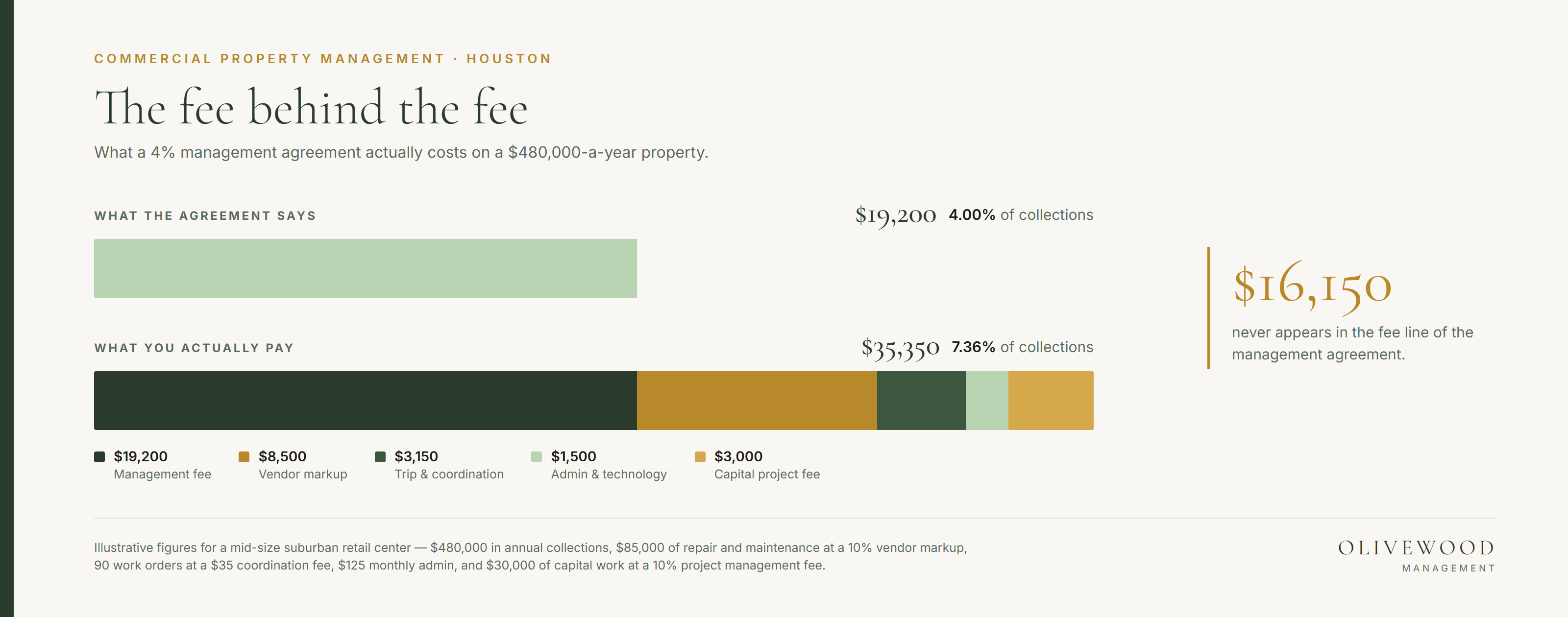
| Fee structure and alignment | 5% | Fee tied to collected revenue, no hidden maintenance markups, no long lock-in |
A candidate that scores under 3 on either of the two 20% criteria is not a fit for a commercial asset regardless of the rest. Maintenance and money are where retail and office properties are won or lost.
Criterion 1: In-house maintenance capability
When a manager outsources every work order to third-party vendors, you lose control of quality, response time, and cost — and you usually pay a coordination markup on top of the invoice. An in-house maintenance team means a tenant's roof leak is a phone call, not a procurement exercise. Ask to see their work-order log for the last 90 days, with time-to-close.
Criterion 2: CAM and financial accuracy
On NNN retail, most of your operating cost is passed through to tenants — which means the accuracy of that passthrough is your margin. A manager who cannot show you a sample year-end CAM reconciliation, with the pool definitions and the gross-up method, is guessing with your money. Insist on itemized monthly financials: income, expenses, collections aging, and the maintenance log.
Criterion 3: Lease administration
Commercial leases carry dates that cost real money when missed — renewal option windows, rent escalations, co-tenancy triggers, expiration notices. Ask how those dates are tracked and who is accountable. The answer should be a system, not a person's memory. This is the quiet half of tenant relations, and it is where below-market extensions come from.
Criterion 4: Tenant retention and coordination
Turnover on commercial space is expensive — downtime, tenant improvements, commissions, and make-ready work stack up fast, as our tenant turnover cost breakdown shows, and BLS Producer Price Index data has nonresidential construction inputs holding well above their pre-2021 baseline, so every build-out costs more than the last one. Score the manager on their renewal process and on how they handle a new tenant's build-out. Tenant coordination — construction oversight, insurance and lien-waiver review, draw processing, and move-in — is a discipline, and most managers do not have it.
Criterion 5: Life-safety and compliance
Fire alarm inspections, sprinkler certifications, emergency lighting tests, backflow preventers, elevator certificates. Someone owns that calendar or the fire marshal does. Ask for the life-safety inspection schedule for a comparable property.
Criterion 6: Reporting and technology
A modern manager gives you an owner portal with real-time financials, documents, and the work-order history, and gives tenants a portal for maintenance requests. If the answer is spreadsheets and email threads, the firm will not scale with you.
Criterion 7: Local submarket knowledge
Houston's submarkets behave differently. Rental rates, tenant mix, and the operational quirks — flood exposure, deed restrictions, MUD taxes — vary from The Woodlands to Pearland. Your manager should be able to name the comparable centers or buildings within a few miles of yours without looking them up.
Criterion 8: Fee structure and alignment
The true cost of a management fee is rarely the headline percentage. Ask what is marked up (maintenance, construction management, leasing), what the termination terms are, and whether the fee is charged on scheduled or collected rent. The right structure pays the manager when you get paid.
A Sugar Land Office Building, Scored Three Ways
Last year an owner brought us a 31,600 SF two-story office building in Sugar Land — 84% occupied, eleven tenants on modified-gross leases — while interviewing three firms, including the incumbent. The owner used a version of the scorecard above.
The incumbent scored well on reporting and local knowledge, and poorly on the two 20% criteria. Every work order was subcontracted at a 12% coordination fee, and the prior year's expense reconciliation had allocated the full parking-lot resurfacing — $48,000 — into the operating pool as a single-year expense instead of amortizing a capital item, which two tenants had already disputed. A national firm scored highest on technology and lowest on maintenance response, with a stated 48-hour target for non-emergency work orders. The third firm, ours, scored highest on maintenance and CAM and lowest on portfolio size.
The owner chose on the weighted score, not the brand. In the first year the reconciliation was rebuilt with the resurfacing amortized over ten years, the two disputes were settled without concessions, and average work-order close time dropped from just under four days to 26 hours. Occupancy went from 84% to 93% at renewal season, largely because the tenants who had been disputing their reconciliation stopped looking for an exit. None of that shows up in a star rating.
Questions That Sort Operators From Administrators
Ask every candidate these, and write down the answers:
- Do you have in-house maintenance staff, or do you subcontract everything — and what is your markup on subcontracted work?
- Show me a redacted year-end CAM reconciliation for a comparable property.
- How are lease critical dates tracked, and who is accountable when one is missed?
- What is your average work-order close time, and how do you know?
- Who handles a new tenant's build-out, and what documents do you collect before construction starts?
- Who owns the life-safety inspection calendar?
- What does the owner portal show me, and how often is it updated?
- Which of your current properties is most like mine, and can I speak with that owner?
Red Flags
- A management proposal that never mentions the roof, the HVAC, or the parking lot
- "We use a network of trusted vendors" as the entire maintenance answer
- No sample financial package, or a sample that is a one-page summary
- Fees quoted on scheduled rent rather than collected rent
- A contract longer than twelve months with a termination penalty
- Residential credentials presented as commercial experience. Owner-occupied houses and apartments are a different business; the competencies diverge on lease structure, capital planning, and recoveries (see IREM's commercial management resources), and so does the manager you need
Why Olivewood Belongs on Your Shortlist
We built Olivewood Management around the two criteria that carry 40% of the scorecard, because that is where retail and office owners lose money:
- In-house maintenance and a sister contractor. Routine work is done by our own team, and post-storm or post-construction cleanup goes to MSM Services Texas, which has serviced Houston commercial properties since 2018. No procurement delay, no coordination markup.
- Engineering-led financials. Itemized monthly reporting, CAM reconciliation built from the lease pool definitions, and a capital plan for every major system — so recoveries are recovered and surprises are scheduled.
- A documented onboarding and audit playbook. Every property we take over gets a lease abstract, a critical-date calendar, a life-safety inspection schedule, and a maintenance baseline in the first 30 days, all visible in the owner portal.
If you are a Houston-area retail or office owner comparing managers, the cost of choosing on reputation instead of operations is a reconciliation dispute, a missed renewal window, or a roof that fails into a tenant's ceiling. Request a free, no-obligation consultation and we will score your property on this same card — including where we are not the right fit. Start with our overview of commercial property management in Houston if you want the full picture first.
Ready to talk about your property?
Schedule a consultation with the Olivewood team — we'll come prepared.
Schedule a ConsultationRelated Reading

Property Management vs. Facilities Maintenance: Which One Your Retail Center or Office Building Actually Needs

What a Vacant Suite Actually Costs: Tenant Turnover Math for Houston Commercial Owners