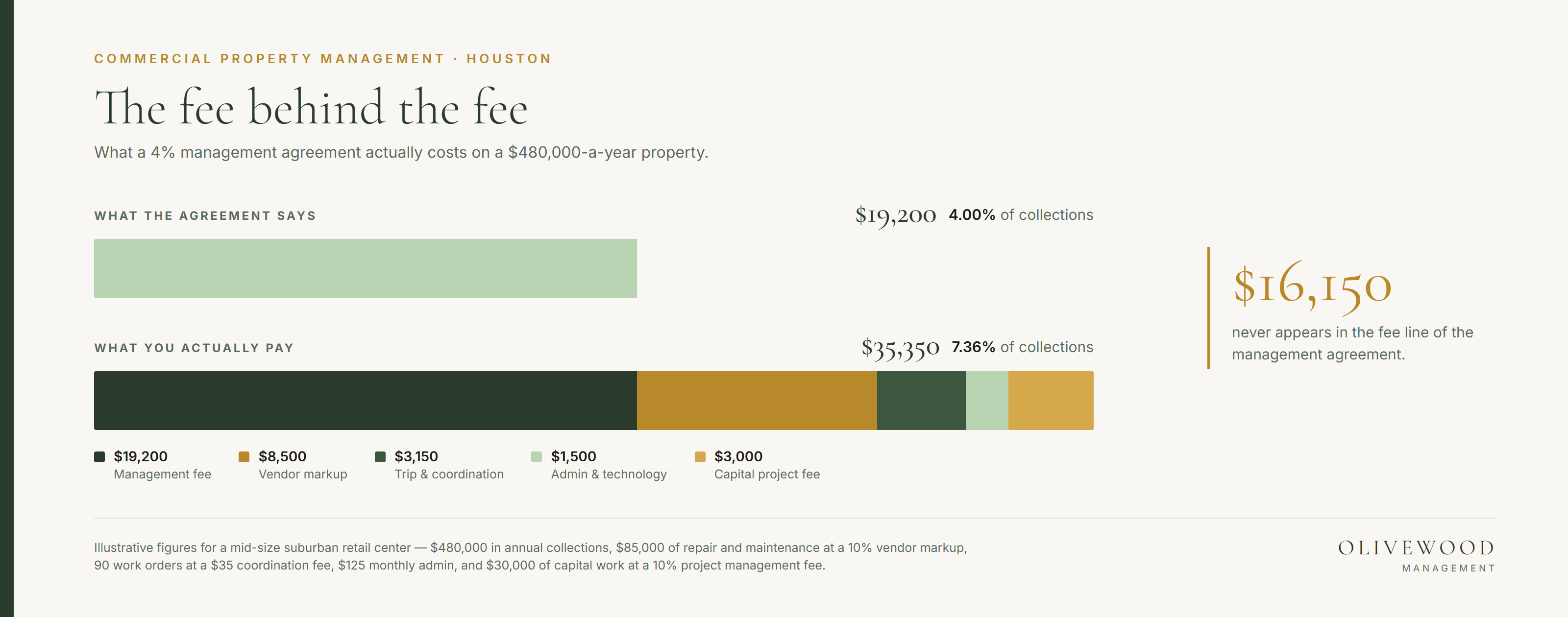
Every Houston commercial owner who has ever hired a management company has done the same thing: lined up three proposals, found the percentage on page one of each, and picked from there. Four percent beats four and a half. Three and three-quarters beats four.
That comparison is close to meaningless, because the management fee is rarely the largest thing you pay your manager. It is simply the only number written in a font large enough to notice.
The rest of the money leaves through four other doors — vendor markup, coordination fees, administrative and technology charges, and a percentage skim on capital work. None of them appear in the proposal summary. All of them appear on your statements, month after month, in amounts small enough that nobody adds them up. This post adds them up, gives you a calculator to run your own property, and shows what the exercise looked like on a real center we took over.
The Four Charges That Ride Alongside the Fee
1. Vendor markup
This is the big one. Your manager receives a $2,400 invoice from an HVAC contractor and bills you $2,760. The 15% difference is described in the agreement as "administrative overhead," "vendor coordination," or nothing at all — many agreements simply say invoices are billed "as incurred by Manager," which quietly makes the marked-up number the incurred number.
The structural problem is not the percentage. It is the incentive. A manager who earns a cut of every repair dollar has no financial reason to make repairs cheaper, and every reason to replace rather than fix. That conflict is exactly why we argued that in-house maintenance beats outsourcing — the markup model pays your manager most when your building costs you most.
2. Coordination and trip fees
A flat charge — commonly $25 to $75 — applied every time a work order is dispatched. On a quiet office building with 20 calls a year, it is a rounding error. On a retail center with eight tenants, a shared trash enclosure, and a parking lot that collects shopping carts, it lands 100 to 150 times a year and becomes a line item worth arguing about.
3. Administrative and technology fees
A monthly charge for the portal, the statements, and the software. Fair enough on its face. The question worth asking is what the charge actually buys you, because "technology fee" covers everything from a genuine owner-facing platform to a PDF emailed on the twelfth of the month.
4. Project management fees on capital work
A percentage — usually 5% to 10% — of every capital dollar spent. Re-stripe the lot, replace three rooftop units, repair a roof section after a hailstorm, and the manager takes a cut of the total. Read this clause carefully: many are written broadly enough to apply to insurance claim proceeds, which means a storm you did not cause generates a fee you did not expect.
Run the Numbers on Your Own Property
The calculator below takes all five components and produces one number: what management actually costs you in a year, and what percentage of collections that really is.
Management Fee True-Cost Calculator
Enter your property's numbers to see what management actually costs you in a year — and what percentage of collections that really works out to.
Base rent plus recoveries, across the whole property
The headline percentage in your agreement
What the work actually costs before any markup
Often buried as "administrative overhead" — typically 10-20%
Every tenant call that generates a dispatch
Charged per dispatch, whether or not a vendor is needed
Portal, statement, and software charges
Roof sections, parking lot work, HVAC replacements
A percentage of every capital dollar, on top of the base fee
What you pay in a year
- Base management fee
- $19,200
- Vendor markup
- $8,500
- Coordination / trip fees
- $3,150
- Admin & technology fees
- $1,500
- Capital project management fee
- $3,000
- All-in annual cost
- $35,350
Headline fee vs. what you actually pay
$16,150 per year of what you pay never appears in the fee line of your management agreement.
Estimates only, based on the figures you enter. Every agreement is written differently — read yours against these five categories before you compare two proposals.
The values it opens with describe an ordinary mid-size suburban center — roughly $480,000 in annual collections, a 4% headline fee, $85,000 of repair and maintenance, 90 work orders, and $30,000 of capital work. Fairly standard terms across the board. Nothing predatory, nothing unusual.
Those inputs produce an all-in cost of $35,350, or 7.36% of collections — very nearly double the 4% the owner believes they are paying. Sixteen thousand dollars a year sits outside the fee line of the agreement.
Now change one number. Drop the vendor markup to zero, the way it works when the crew doing the work is on your manager's payroll rather than a subcontractor's, and the same property costs $26,850 — even though the headline fee never moved. That single term is worth more than the entire difference between a 3.5% manager and a 5% manager.
What This Looked Like on a Sugar Land Center
We took over a 19,400 SF retail center in Sugar Land — seven suites, all NNN, 86% occupied at transition. The owner had hired the previous manager three years earlier on a 3.75% fee, the lowest of the three proposals received. He was happy with that decision until we ran the prior twelve months of statements as part of transition.
| Charge | Annual amount |
|---|---|
| Base management fee — 3.75% of $612,000 collected | $22,950 |
| Vendor markup — 15% on $96,000 of maintenance | $14,400 |
| Coordination fee — $50 across 112 work orders | $5,600 |
| Administrative and technology fee — $175/month | $2,100 |
| Project management — 10% on $128,000 of roof and parking work | $12,800 |
| All-in annual cost | $57,850 |
That is 9.45% of collections against a 3.75% agreement. The owner had signed the cheapest proposal on the table and paid the highest effective rate of the three.
The markup line is the one worth sitting with. On $96,000 of maintenance, $14,400 went to a company that did not turn a wrench — it forwarded invoices. And because the same company chose the vendors, nobody was checking whether $96,000 was the right number in the first place. When we rebid the recurring scopes under our vendor management program, three of the six contracts came back materially lower for identical scope, and two of the vendors had never been competitively bid at all.
Through the first full year under Olivewood, the owner's all-in management cost ran about 5.6% of collections. The headline fee went up. The total went down by roughly $23,000. At a 7.5% cap rate, that recurring saving is worth just over $300,000 in asset value — which is the point we keep making about operational levers and NOI: the money is almost never in the fee negotiation, it is in the structure underneath it.
Five Questions to Ask Before You Sign
- Are vendor invoices passed through at cost? Ask for the answer in writing, as a sentence in the agreement, not a verbal assurance. Then ask whether the manager owns or is affiliated with any of the vendors.
- What triggers a coordination or trip fee, and what is the annual cap? If there is no cap, ask what last year's total was on a comparable property.
- Does the project management fee apply to insurance proceeds? In a market that reliably produces hail and wind claims, this clause matters more here than almost anywhere else.
- What does the technology fee actually buy? Ask to watch the software run before you sign anything. Ours is public — you can watch the Olivewood platform tour on YouTube or see the same walkthrough on our technology page, including the maintenance queue and the owner reporting, without talking to a salesperson first.
- What is the all-in number on a property like mine? Any manager who cannot produce it from their own book of business either does not track it or would rather you did not see it.
We covered the broader version of this diligence in how to evaluate a commercial property management company, and the contract-language version in what to know before signing a facilities maintenance contract.
Why the Markup Model Gets Worse Every Year
A percentage markup is indexed to your costs, and your costs have been climbing. Producer Price Index data from the Bureau of Labor Statistics shows nonresidential construction and maintenance inputs holding well above their pre-2021 baseline. The same rooftop unit, the same parking lot repair, the same plumbing call all cost more than they did four years ago — and a manager on a 15% markup collects more every year for doing exactly the same amount of forwarding.
You never renegotiate that raise. It arrives automatically, embedded in invoices you approve one at a time.
One more piece of housekeeping while you have the agreement open: commercial property management in Texas is brokerage activity, and the company doing it should hold an active license. You can confirm that in about thirty seconds using the Texas Real Estate Commission license holder search. It is worth the thirty seconds.
Why Olivewood Is the Right Partner for This
Fee transparency is not a policy we adopted — it falls out of how the company is built.
- The maintenance crew is ours. We are not marking up a subcontractor's invoice, because there usually is not one. Work orders across Katy, Sugar Land, Pearland, and Cypress are handled by people on our payroll, which removes the markup layer and the incentive that comes with it.
- Larger scopes stay in the family, priced as scope. Our sister company MSM Services Texas handles janitorial, post-construction cleaning, and restoration work directly, so capital and turnover projects run under one accountable party instead of a stack of subcontractor margins. Anything we do bid out goes through competitive facilities maintenance bidding with the quotes shown to you.
- The statements show the arithmetic. Our in-house property accounting team produces CPA-ready monthly reporting where the fees are visible line items, not a single blended number you have to reverse-engineer.
If you are a Houston-area commercial owner and you cannot say — today, without looking — what percentage of collections your management actually costs, that is the finding. Run the calculator above against your last twelve months of statements. If the effective number lands well above the headline number, you are not paying for management. You are paying for the privilege of having someone else approve invoices.
Schedule a free, no-obligation consultation with the Olivewood team. We will read your current agreement, run your statements through the same five categories, and give you the all-in figure in writing — whether or not you end up hiring us. That is what full-service commercial property management in Houston should look like before the first dollar changes hands.
Ready to talk about your property?
Schedule a consultation with the Olivewood team — we'll come prepared.
Schedule a ConsultationRelated Reading
The Mid-Year CAM Reconciliation Checkpoint: What Houston Commercial Owners Should Be Doing Right Now
Property Taxes on Houston Suburban Retail Centers: When a Cost Segregation Study Is Worth the Investment