If you own a commercial property in the Greater Houston area with NNN or modified-gross leases, you already know that common area maintenance (CAM) charges are one of the most operationally important — and most frequently mishandled — line items in your portfolio. We covered the broader picture in our NOI optimization post, where CAM leakage topped the list of places Houston owners leave money on the table. This post zooms in on the mid-year checkpoint that actually keeps that leakage from happening.
By May, the calendar-year clock is roughly 40% gone. The expenses you have already paid — landscaping, utilities, parking lot maintenance, pest control, insurance allocations — are locked in. The reconciliation you will have to send tenants in February or March of 2027 is being shaped by the books you are keeping right now.
The owners who wait until December to look at CAM are the ones who end up writing checks back to tenants for overcharges, scrambling to explain variances, or quietly absorbing the difference because the math is too far gone to fix. The owners who run a mid-year audit catch the problems while there is still time to correct them.
Here is what that mid-year checkpoint should actually look like.
Why the Mid-Year Mark Matters
CAM reconciliation, by its nature, is a year-end activity. You estimate annual operating expenses, you collect monthly from tenants based on those estimates, and at year-end you reconcile actual to estimated and either bill or refund the difference.
That structure has a built-in problem: if your estimates are wrong, you do not find out until 10–12 months of activity has already accumulated. A small monthly variance becomes a meaningful year-end true-up — and a meaningful year-end true-up becomes a tenant relations problem, an audit request, or a refund check.
A mid-year review compresses the feedback loop. You can see which line items are tracking above or below budget, adjust your monthly estimates for the back half of the year, and head into Q4 with a reconciliation that is mostly already done. Tenants get a smaller true-up. You get a cleaner book.
For NNN retail strip center owners in particular, where vacant suite carrying costs compound quickly, the mid-year checkpoint is also where you catch any pro-rata share allocations that have drifted out of sync with actual occupancy.
A Real Mid-Year Audit: What We Caught on a Katy Strip Center
Last summer we took over property management on a 14,200 SF strip center in Katy — six suites, all on NNN leases, 78% occupied at the time of transition. The previous manager had been handling the property for three years and produced a tidy-looking monthly statement, so on the surface everything appeared in order.
We ran our standard mid-year CAM checkpoint as part of onboarding. Two findings stood out:
- No gross-up was being applied. Every lease in the building included a 95% gross-up provision allowing the owner to recover CAM as if the building were near-full, but the prior manager had been calculating each tenant's share against actual 78% occupancy. The vacant suites' share of landscaping, parking lot maintenance, exterior utilities, and pest control was being silently absorbed by the owner — about $19,400 a year.
- The 12% CAM administrative fee in every lease had never been billed. Not once. On roughly $124,000 of annual CAM, that was another $14,900 of revenue the owner was entitled to and had simply not collected.
Combined, the owner had been giving up roughly $34,300 a year for three years — over $100,000 of recoverable CAM that quietly walked out the door. At a 7.0% cap rate, the annual gap alone represented about $490,000 of suppressed asset value.
We adjusted the monthly CAM billing in July, issued a written explanation to each tenant outlining the gross-up provision and the admin fee per their lease, and provided supporting math. Two tenants had follow-up questions, both of which were resolved with one phone call and a copy of the lease clause. The year-end reconciliation came in within $1,800 of estimate.
The point of the story is not that the prior manager was malicious. It is that nobody had ever looked. CAM problems hide in plain sight until somebody runs the checkpoint.
Five Things to Audit at the Mid-Year Mark
1. Budget vs. Actuals by Line Item
Pull your year-to-date P&L for the property and compare it line by line to the operating budget you used to set this year's CAM estimates. You are looking for two things: which categories are running hot, and which are running cold.
Common Houston offenders:
- Utilities — A single freeze event or a hot summer can blow through the budget on common area electricity and water. According to the U.S. Bureau of Labor Statistics Producer Price Index for utilities, commercial natural gas and electric service prices have moved meaningfully year over year and are worth checking against any escalation assumption you baked into your CAM estimate. Houston summers consistently push HVAC load and the corresponding electrical bills above projections.
- Landscaping — Drought conditions, irrigation repairs, and tree work after weather events often add unbudgeted costs.
- Parking lot maintenance — One pothole repair or restriping job can swing this line meaningfully.
- Insurance — If your renewal hit between January and May, you already know whether your CAM estimate covered the new premium. The Texas commercial market has been moving fast.
If any line item is more than 15% over or under budget at the halfway point, that is a flag. Either your estimate was off, your spend is irregular, or something has changed operationally.
2. Vendor Invoices and Expense Coding
CAM reconciliation only works if every operating expense is correctly coded to the right property and the right CAM category. This is where the most preventable mistakes happen.
Things to verify on a mid-year sample:
- Invoices are coded to the correct property (a common error when a manager runs multiple buildings)
- CAM-eligible expenses are not being miscoded as capital improvements, or vice versa
- Pass-through utility allocations match the lease language
- Any vendor change since the prior year has not introduced a new line item that is not yet in your CAM pool
If your property manager cannot produce a year-to-date expense detail tied to specific invoices on request, you have a transparency problem worth solving before December.
3. Vacancy and Gross-Up Adjustments
This one matters most for owners with NNN leases and partial occupancy — exactly the situation that cost the Katy owner above. Most modern commercial leases include a gross-up provision allowing the owner to recover CAM as if the building were 95% occupied, which protects you from absorbing the vacant share of common costs.
At the mid-year mark:
- Confirm gross-up is actually being applied where your leases allow it
- Verify the occupancy denominator being used matches reality, and that any new vacancies have been incorporated
- Check that tenant pro-rata shares have been recalculated if the suite mix has changed
A property at 80% occupancy that is not grossing-up CAM is silently bleeding NOI every month.
4. Pass-Through Caps, Exclusions, and Controllable Expenses
This is the area where lease language and operating reality drift the furthest apart. Tenants — especially national retail tenants — frequently negotiate:
- Caps on controllable CAM (often 4–6% annual increases)
- Exclusions for capital items, certain professional fees, marketing, or first-year repairs
- Carve-outs for any expense related to a portion of the property they do not use
If your property manager is billing CAM without referencing those provisions, you are going to refund money in February. Pull two or three leases at random, walk through the CAM clauses, and confirm the year-to-date billing actually respects them.
5. Admin Fee and Management Fee Accuracy
Many leases allow the owner to collect a CAM administrative fee — typically 10–15% of total CAM — as compensation for the work of running the common areas. It is a real revenue line, and as the Katy example shows, it is the one most frequently left uncollected.
Verify:
- The admin fee percentage in each lease is being applied
- The fee is being calculated on the correct base (some leases exclude certain expenses from the admin fee calculation)
- Management fees, where chargeable to CAM, are properly distinguished from the admin fee
A 12% admin fee on $180,000 of annual CAM is $21,600 of revenue. Missing it for a year is a real number.
What Mid-Year CAM Leakage Looks Like
For a typical Houston suburban strip center with $180,000 in annual CAM and 85% occupancy, here is what the most common mid-year findings translate to in dollars:
| Issue | Typical Annual Impact | Detected Mid-Year |
|---|---|---|
| No gross-up applied at 85% occupancy | $14,000–$22,000 | Recoverable for remainder of year |
| Admin fee uncollected (12% of CAM) | $20,000–$22,000 | Fully recoverable going forward |
| Miscoded vendor invoices | $3,000–$8,000 | Correctable before year-end |
| Pass-through cap miscalculation | $2,000–$10,000 | Refund avoided |
| Utility variance unbudgeted | $4,000–$12,000 | Estimate adjustable for Q3–Q4 |
| Total potential impact | $43,000–$74,000 |
At a 7% cap rate, that is between $614,000 and $1.06 million in asset value — sitting in a checkbox most owners do not review until February.
What Good Mid-Year CAM Reporting Looks Like
A property manager who is running CAM correctly should be able to produce — without notice — a mid-year package that includes:
- Year-to-date P&L with budget comparison and variance commentary
- Detailed vendor invoice register sorted by CAM category
- Updated occupancy schedule and pro-rata share calculation
- Lease abstract showing CAM caps, exclusions, and admin fee terms by tenant
- Projected year-end reconciliation estimate, with recommended adjustments to monthly billing
If your manager needs two weeks to assemble this, it does not exist as a real process. That is the difference between transparent CAM administration and the kind that quietly costs you money.
For broader context on commercial CAM best practices, BOMA International and IREM (Institute of Real Estate Management) both publish detailed guidance for owners and managers on operating expense pass-throughs and reconciliation standards.
Communicate Proactively With Tenants
The cleanest way to defuse a year-end reconciliation dispute is to flag any meaningful variances mid-year. A short note to tenants saying "based on year-to-date activity, your estimated CAM will be adjusted from $X to $Y for the remainder of the year" is far easier to absorb than a five-figure true-up bill in February.
Proactive communication also protects you in the rare cases where a tenant disputes the reconciliation. A documented mid-year notification, with the variance reasoning, is the kind of paper trail that makes audits short and resolutions quick.
Why Olivewood Is the Right Partner for This
Most property management companies in the Houston market treat CAM as a year-end deliverable. We treat it as a year-round process — and the math above is exactly why.
For every commercial property we manage across Houston, Katy, Sugar Land, The Woodlands, Cypress, Pearland, Fulshear, Conroe, Magnolia, Tomball, Missouri City, League City, and Kingwood, mid-year CAM review is a scheduled deliverable, not a request-driven scramble. Every June, owners in our portfolio receive a budget-vs-actuals package by line item, a vendor invoice audit summary, a current rent roll with pro-rata share calculations, and a projected year-end reconciliation estimate with any recommended adjustments to monthly CAM billing.
Three structural advantages drive the difference:
- In-house facilities maintenance and vendor management — our facilities maintenance programs and vendor management oversight, executed by an in-house maintenance team, keep controllable CAM categories tightly tracked, properly coded, and competitively priced. The same crew that performs the work also generates the documentation, which keeps invoices clean and reconciliations defensible.
- Coordination with our sister company — MSM Services Texas handles janitorial, pressure washing, post-construction cleanup, and emergency restoration across Greater Houston. Common-area services that frequently get miscoded or double-billed under other managers come through a single, accountable vendor relationship.
- A documented onboarding and audit playbook — the Katy story above is not an exception. We catch a version of those findings on the majority of properties we onboard, because we look for them on day one. That is also the work covered in our evaluation checklist for Houston property management companies.
If you are a commercial property owner in the Greater Houston area and you are not getting a mid-year CAM package, you are almost certainly leaving recoverable revenue on the table. Schedule a free, no-obligation CAM review with the Olivewood team — we will pull your year-to-date operating expenses, walk through your lease pass-through structure, identify the variances worth correcting before year-end, and tell you in writing what we would change if we were managing the property. The best year-end reconciliation is the one you have already mostly done — and the right property management partner in Houston is the one who already did it.
Ready to talk about your property?
Schedule a consultation with the Olivewood team — we'll come prepared.
Schedule a ConsultationRelated Reading
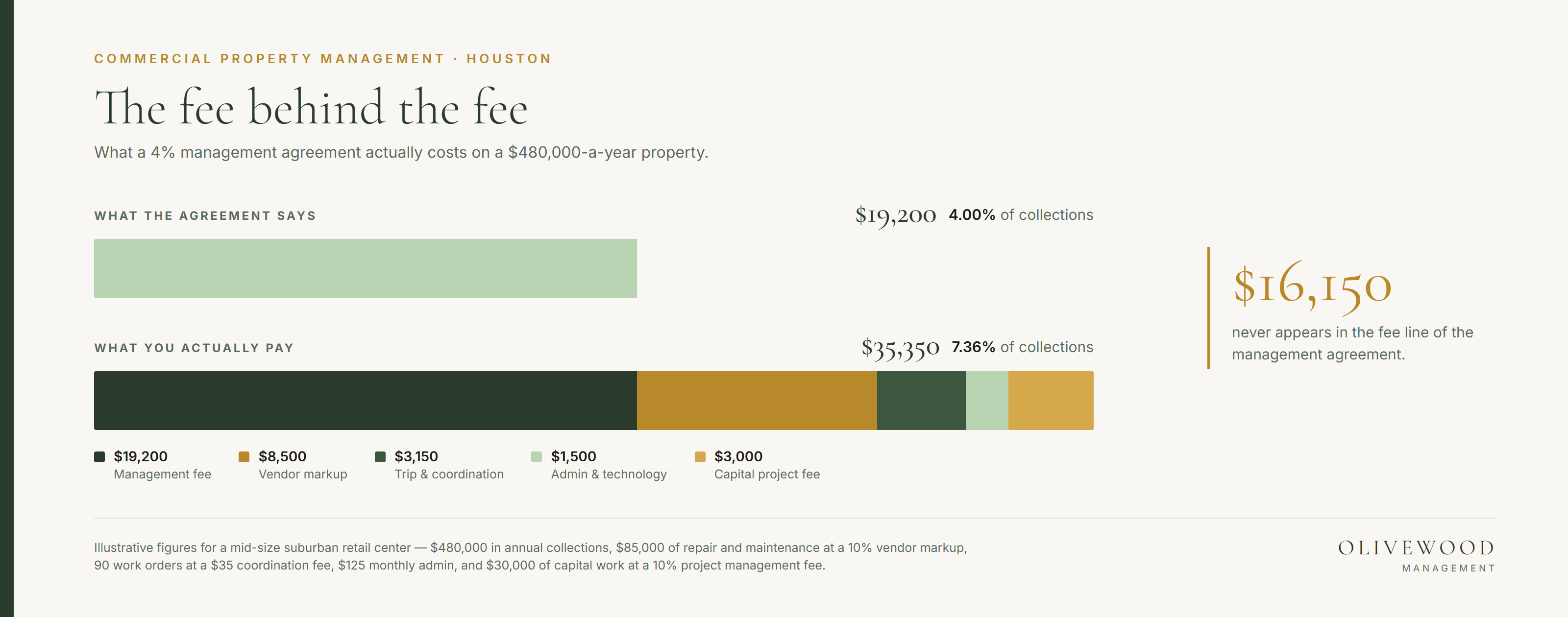
The Fee Behind the Fee: What Commercial Property Management Actually Costs Houston Owners
Property Taxes on Houston Suburban Retail Centers: When a Cost Segregation Study Is Worth the Investment